





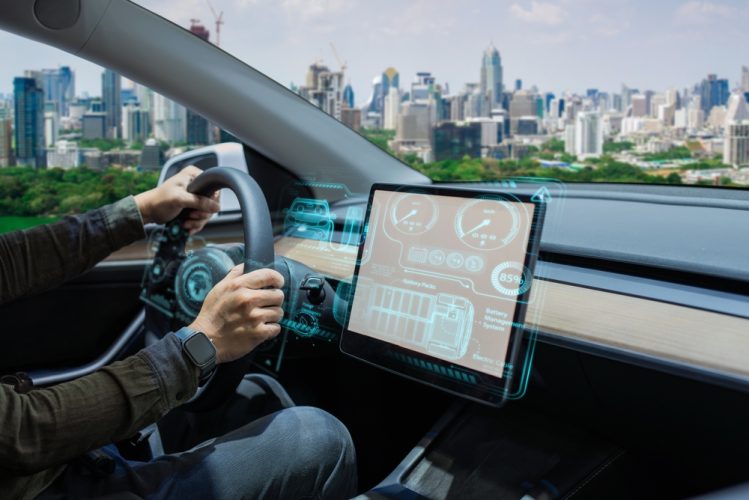
The European Union just stuck a camera in every new car – pointed directly at the driver's face.
Bureaucrats in Brussels promised the footage stays in the car.
What carmakers already do with that footage is something Brussels refuses to answer for.
EU Driver Monitoring Camera Now Mandatory in Every New Car
On July 7, every new car registered across the EU's 27 member states came factory-fitted with a government-mandated infrared camera aimed at the driver's face.
Brussels calls it Advanced Driver Distraction Warning – ADDW for short.
The camera tracks eye movement, head position, and gaze direction in real time, judging whether a driver has looked away from the road for too long.
At highway speed, the threshold is 3.5 seconds.
Glance at a phone – warning.
Check on children in the backseat – warning.
Look at the radio for six seconds at lower speeds – warning.
The system cannot be permanently disabled.
Switch it off before a trip and it resets the next time the engine turns over.
Martin Krantz, CEO of Swedish AI company Smart Eye – one of the leading manufacturers of ADDW technology – told the Daily Caller News Foundation this week the system will eventually stand alongside seat belts and airbags as standard safety equipment.
"It's a life-saving technology," Krantz said. "It really helps to prevent accidents."
"No one's going to call the authorities, and no one's going to tell on you," Krantz told the DCNF – then added: "but it's going to be different for different car makers."
Car Surveillance Data: No Audit, No Answers
The EU's General Safety Regulation requires ADDW systems to operate on a so-called closed loop.
The biometric data – eye movements, gaze patterns, head position – is supposed to stay on the head unit and go nowhere else.
Here is the problem: the General Safety Regulation specifies no independent audit mechanism to verify any of that.
All About Cookies investigated the mandate on July 7 and found the regulation leaves the definition of "necessary" data entirely open to manufacturer interpretation.
If no regulator ever inspects the actual data flow, the closed-loop promise is whatever each carmaker decides it is.
Early real-world testing found these cameras fire warnings constantly – even during ordinary driving.
The European Conservative documented the backlash, noting the system "confuses blinking with drowsiness" and issues break alerts on short trips.
The car industry's track record on privacy promises is a disaster.
A major 2023 consumer privacy audit reviewed 25 of the world's biggest car brands.
Every single brand received a "Privacy Not Included" warning.
All 25 brands collected driver data beyond what the vehicle needed to operate – and put it to commercial use that had nothing to do with getting anyone from point A to point B.
Fifty-six percent said they would share driver information with law enforcement without requiring a court order.
One driver's data profile ran 258 pages, logging nearly every trip over six months.
That driver's insurance premium jumped 21 percent based on that data.
These are the same manufacturers now entrusted with footage from a government-mandated camera pointed at every driver's face.
Driver Monitoring Cameras Are Coming to American Cars by 2027
The European Conservative called the mandate "surveillance disguised as safety."
They're right.
The EU's General Safety Regulation functions as a de facto global standard – the same way GDPR reshaped American corporate data practices from Brussels whether American companies wanted it to or not.
Car manufacturers build unified platforms, not market-specific hardware.
Once cameras are standard equipment on EU-spec vehicles, the hardware ships globally – enabled by default.
Federal regulators are already preparing similar driver monitoring requirements for American vehicles by 2027.
The carmakers who promised Brussels that biometric data never leaves the head unit already confirmed they hand information to police without a subpoena.
Those same cameras – now standard in more than 10 million European vehicles a year – are headed to American dealerships.
And the regulatory gap comes with them: no audit mechanism, no enforcement teeth, no way to verify what actually happens to the footage.
Europe built the infrastructure.
America is next in line.
And the moment law enforcement calls a manufacturer and asks what the camera saw, the answer will depend entirely on what that particular company decided "closed loop" means.
That is not a hypothetical.
More than half the industry already confirmed it is standard practice.
The camera does more than flag distracted drivers.
It tracks when a driver is behind the wheel, how long the engine ran, and when the vehicle was in use.
That is not just a safety system – that is a usage log.
The same political class that wants to eliminate gas-powered vehicles and penalize carbon emissions now has a ready-made compliance mechanism sitting inside every new car sold in Europe.
When a future climate scheme needs an enforcement tool – limits on how far anyone can drive, how often, under what conditions – the infrastructure will already be installed.
The camera is already there, pointed at the driver's face, logging every moment the vehicle is in use.
The hardest part is already done.
Converting a safety camera into a compliance tool costs nothing but a regulation and a software update.
Americans bought their cars for the open road – no one watching, no one tracking where they went or how long they stayed.
Brussels just changed that.
Washington is next.
Sources:
- Dylan Kresak, "European Cars Now Must Track Drivers' Eye Movements In Name Of Safety," Daily Caller News Foundation, July 7, 2026.
- Tamás Orbán, "Surveillance Disguised as Safety: Cars Sold in EU To Spy on Drivers 24/7," The European Conservative, July 9, 2026.
- "EU Mandates Driver Distraction Warning Tech in Cars," Traffic Technology Today, July 7, 2026.